
As the Federal Open Market Committee (FOMC) gathers for its April 28–29, 2026 meeting, one message is crystal clear: the era of easy monetary policy is over, at least for now. The U.S. economy remains resilient, but the Federal Reserve faces a complicated balancing act. Inflation has reaccelerated in the headline numbers, driven by a sharp energy spike tied to geopolitical tensions in the Middle East, while the labor market shows clear signs of cooling beneath a still-low unemployment rate.
This is the Fed's new reality: sticky underlying inflation that refuses to cooperate with the 2% target, paired with a slowing labor market that is no longer adding jobs at a robust pace. The result? A likely "higher for longer" interest rate environment that will shape borrowing costs, investment decisions, and household finances well into 2027 and beyond.
The Inflation Surprise No One Wanted
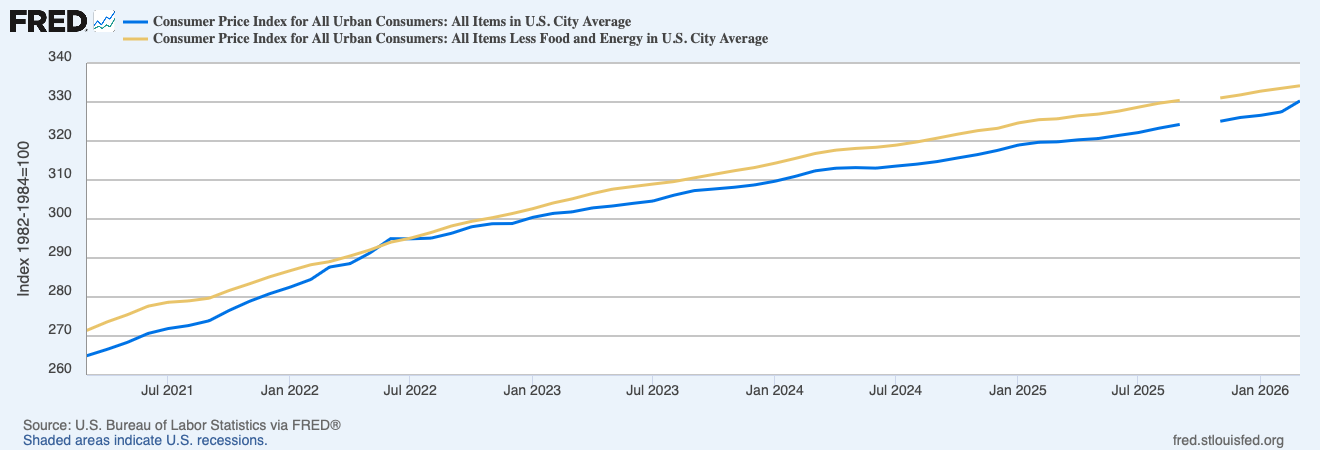
On April 10, the Bureau of Labor Statistics released March 2026 Consumer Price Index (CPI) data that jolted markets and policymakers alike. Headline CPI rose 0.9% month-over-month, the largest gain in over a year, and 3.3% year-over-year, up sharply from 2.4% in February.
The culprit? Energy. Gasoline prices surged as the ongoing conflict involving Iran disrupted oil supplies and WTI briefly surpassed $110/bbl in March. Food prices also remained elevated, with the food index up 2.7% over the past year.
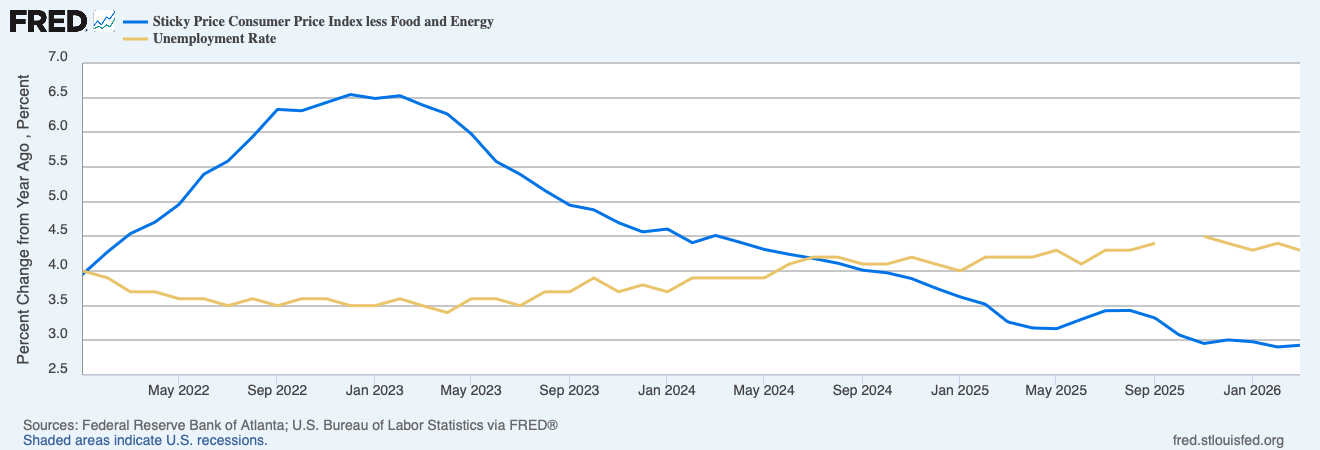
Core CPI (which strips out volatile food and energy) told a slightly better but still concerning story: it rose 2.6% year-over-year, only modestly above February's 2.5% reading. While core has been trending in the right direction for much of the past two years, progress has stalled.
The Federal Reserve's preferred measure, the core Personal Consumption Expenditures (PCE) price index, is projected at 2.7% for all of 2026 in the March Summary of Economic Projections (SEP), before easing to 2.2% in 2027 and 2.0% in 2028.
Why this matters: Headline inflation grabs headlines and affects voter sentiment, but core inflation reveals the underlying trend. When energy prices spike and then fade, headline numbers can look better quickly. But if those spikes feed into wages, rents, or other services prices, inflation becomes "sticky" and harder for the Fed to dislodge without aggressive action.
The Labor Market: Resilient on the Surface, Fragile Beneath
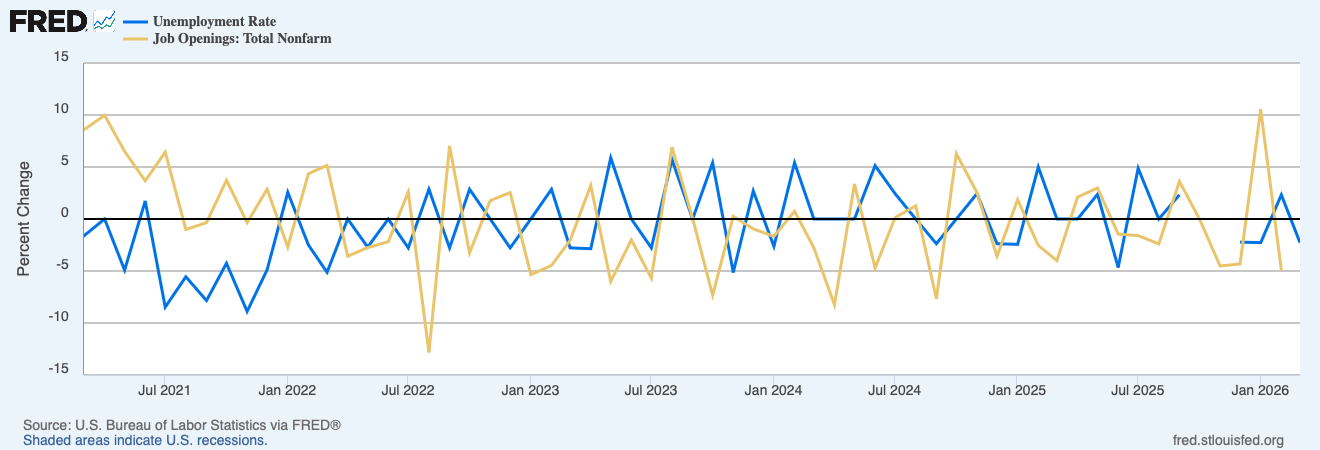
At first glance, the labor market looks healthy. The unemployment rate has hovered around 4.3–4.4% for months, near historic lows and well below the Fed's long-run estimate of ~4.2–4.4%. But dig deeper and the picture changes.
The February JOLTS (Job Openings and Labor Turnover Survey) report showed job openings falling to 6.882 million, the lowest level in years. The hiring rate dropped to 3.1%, its lowest since 2020. Nonfarm payroll growth has slowed markedly, and many economists now describe the market as "low-hire, low-fire." Companies are neither aggressively adding staff nor laying people off in large numbers.
Several factors explain this:
- Sharply lower immigration flows have reduced labor supply growth.
- AI and automation are beginning to substitute for certain roles, particularly in tech, finance, and administrative work.
- Businesses remain cautious after the 2025 government shutdown and amid ongoing policy uncertainty.
The Fed's March SEP projects the unemployment rate at 4.4% for 2026, 4.3% in 2027, and 4.2% in 2028, essentially flat. That stability masks a deeper truth: job growth is barely keeping pace with population increases in many forecasts.
The Dual Mandate in Conflict
The Fed's statutory goals are maximum employment and price stability (defined as 2% inflation over the longer run). For most of 2023–2025, these goals aligned nicely: inflation was falling while the labor market stayed strong. Now they are pulling in opposite directions.
- Inflation side: Energy-driven headline spikes and still-elevated core readings (especially in services and shelter) raise the risk that inflation expectations could drift higher. If households and businesses start expecting 3%+ inflation permanently, it becomes self-fulfilling through wage demands and pricing power.
- Employment side: Further rate hikes or a prolonged hold could tip the already-softening labor market into outright contraction. The "low-hire, low-fire" dynamic is fragile, and a shock could quickly turn into rising layoffs.
This tension is exactly why Fed minutes from the March meeting noted that some participants judged there was a strong case for a "two-sided description" of future policy, meaning the Committee is now explicitly considering both rate cuts and possible hikes depending on incoming data.
"Higher for Longer": What It Actually Means
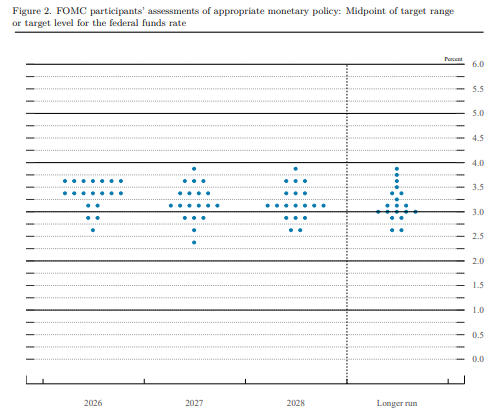
"Higher for longer" is no longer just Wall Street jargon. It means the federal funds rate, currently targeted at 3.50%–3.75%, is likely to stay in this elevated range well into 2027, rather than returning quickly to the near-zero levels of the 2010s or even the 2–3% range many expected in late 2025.
The March dot plot (the "dots" showing each FOMC member's rate projection) shows the median federal funds rate path drifting higher than previous forecasts, with the long-run neutral rate now estimated around 3.1%, the highest since 2016.
Why is this happening?
- The oil shock has pushed 2026 inflation forecasts up.
- The labor market is cooling gradually, not collapsing, so the Fed does not feel urgent pressure to cut aggressively to save jobs.
- Strong corporate profits and AI-driven investment are supporting growth, giving the Fed room to be patient.
Plain-language translation: Think of interest rates like the temperature in your house. The Fed wants the economy at a comfortable 72°F (2% inflation + full employment). Right now the thermostat is set too high because of the energy shock. Instead of immediately turning the AC on full blast (big rate cuts), the Fed is keeping the fan on medium ("higher for longer") until it's sure the temperature will stay down on its own.
What This Means for Everyday Americans and Investors
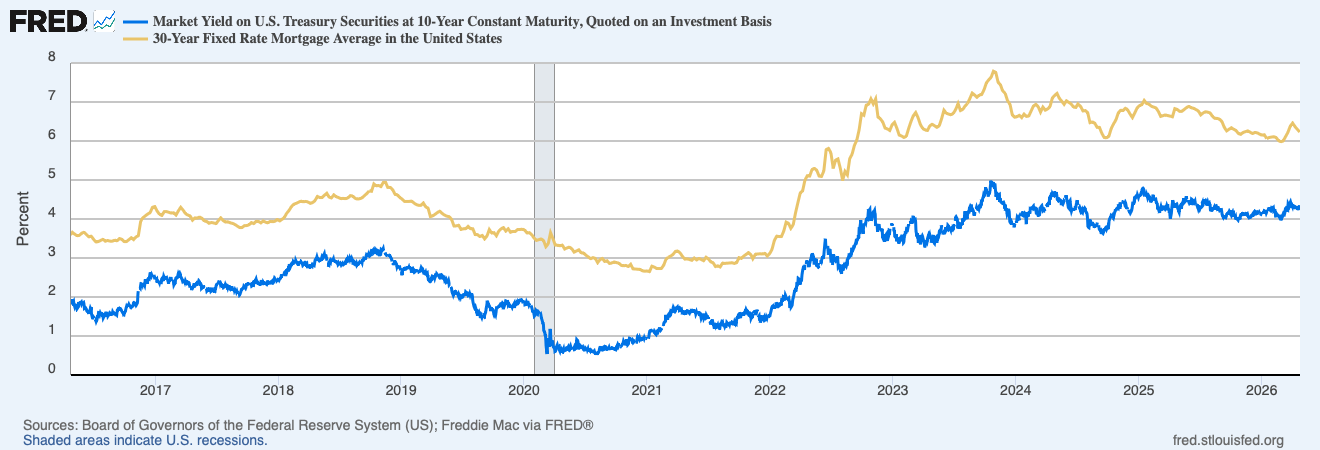
- Borrowers: Mortgage rates, auto loans, and credit cards are likely to stay higher than many hoped. Refinancing a 30-year mortgage may not make sense until late 2027 at the earliest.
- Savers: High-yield savings accounts and CDs yielding 4–5% could remain attractive longer than expected, which is good news for retirees and emergency funds.
- Homebuyers: Affordability remains challenged. Even if home prices cool modestly, the combination of high rates and sticky inflation keeps monthly payments elevated.
- Stock market: Higher rates for longer typically pressure valuation multiples, especially for growth stocks. However, strong earnings growth (projected ~16% for S&P 500 companies in 2026) and AI tailwinds have so far offset much of that pressure.
- Businesses: Higher borrowing costs make expansion and hiring more expensive. Companies with strong balance sheets and pricing power, such as tech, healthcare, and consumer staples, will outperform.
Risks on the Horizon
The biggest near-term wildcard is the Middle East conflict and oil prices. A quick resolution and falling energy costs could reopen the door to rate cuts by late 2026. A prolonged standoff keeps inflation sticky and raises the odds of at least one rate hike later this year, an outcome few expected six months ago.
Other risks include:
- Renewed tariff effects on goods prices.
- Disappointment in AI-driven productivity gains.
- A sharper-than-expected labor market deterioration.
The Bottom Line
The Federal Reserve is no longer in "emergency mode." It is managing a mature but uneven expansion where inflation is proving stickier than hoped and the labor market is cooling from the top. The April 28–29 decision is almost certain to hold rates steady, but the statement and press conference will be scrutinised for any shift in language around "two-sided risks."
For investors and households, the message is clear: plan for a world where the cost of money stays elevated longer than the optimistic forecasts of 2025 suggested. Focus on quality, cash flow, and flexibility. The economy is not in crisis, but the Fed's job has become significantly harder.