
Private credit serves as a key financing avenue for businesses, especially in small and mid-sized sectors, as an option alongside conventional bank financing and capital markets. The sector has expanded substantially, with US assets under management hitting approximately $422 billion at the end of 2025.
In this approach, non-bank lenders extend debt, and recent analyses project global private credit AUM surpassing $2 trillion in 2026, with forecasts approaching $4 trillion by 2030, driven by sustained investor inflows, expansion into asset-backed finance (ABF), and growth in new regions. Companies appreciate its dependability and adaptability, particularly in turbulent markets where broadly syndicated loans (BSL) or bond availability can waver. With stabilizing economies, private credit is both rivalling and supporting BSL, delivering funding when traditional avenues are limited.
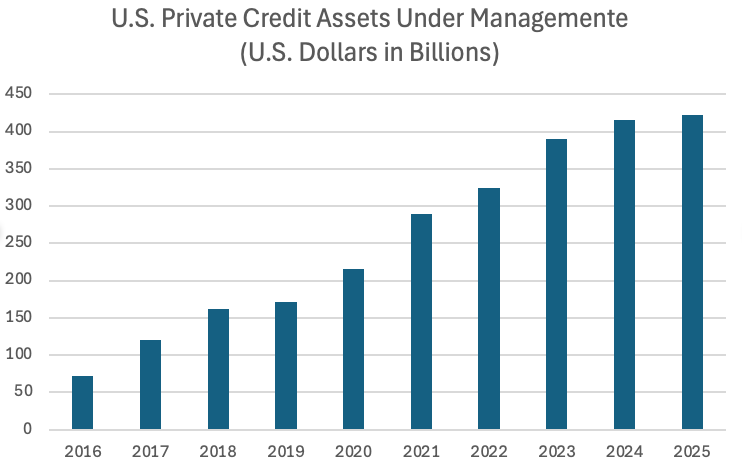
The move to private credit shows in origination figures. US direct lending deal volumes reached approximately $231 billion through the first nine months of 2025, with full-year estimates ranging from $300–$310 billion, indicating strong borrower interest in reliable closings despite competitive pressures. BSL volumes led for lower-rated entities in 2020 and 2021, but by 2022 the markets were roughly equal. From then on, private credit frequently outpaced BSL for B- and lower-rated debt, a pattern holding for the fourth year in 2025. This shift emphasizes private credit's function in bridging voids in sentiment-sensitive public arenas, notably for firms with profiles less appealing to wide audiences.
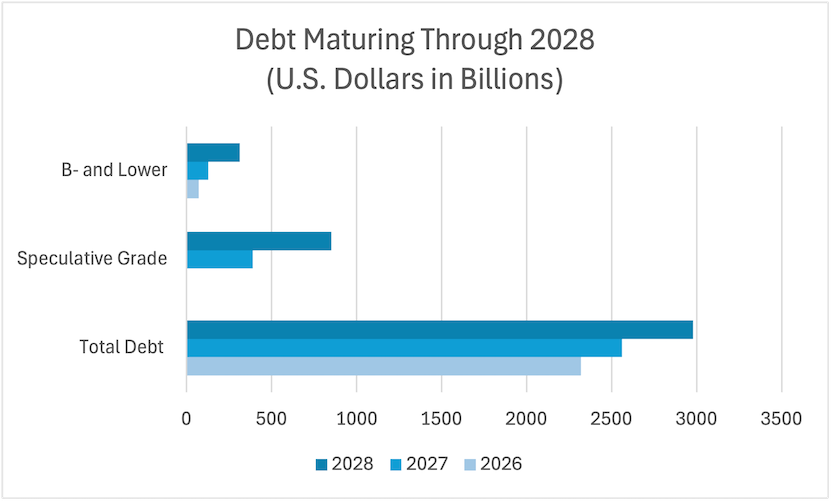
Future refinancing needs will challenge both systems' strength. Projections for US speculative-grade debt expirations show a sharp climb, with roughly $344 billion due from 2026 to 2028, more than half rated B- or below. From about $50 billion in 2026, these climb to a high of nearly $400 billion in 2028, then ease. Joint BSL and private credit originations topped $225 billion yearly in 2024 and 2025, indicating capacity for immediate demands, yet the 2028–2029 spike may call for additional channels. Lower-tier firms are poised to lean on private credit for assured delivery, mixing public and private sources to address growing needs.
Advances in fund financing are merging fund and securitization lines, boosting liquidity for private equity and credit managers. Hybrid structures such as feeder funds, net asset value (NAV) loans, and collateralized fund obligations blend securitization features like tiered credit and event-based triggers, delivering custom adaptability over typical collateralized loan obligations (CLOs). Managers employ these to cover capital call delays, enhance holdings, or offer credit support for limited partners (LPs), including insurers pursuing regulatory capital benefits. As the arena grows, standardization is anticipated, driven by regulatory changes and demands for transparency, with some jurisdiction-specific variations persisting.
Private credit's funders are broadening past banks, incorporating sovereign funds, pension plans, and life insurers adding new capital. Bank advances to private equity and credit funds hit $497 billion in Q2 2025, up 59% from Q4 2024, per the International Monetary Fund. This supports moves into asset-linked funding covering digital infrastructure and transport holdings, plus adaptive multi-strategy funds. Life insurers, aligning extended obligations with complex instruments, accelerate this via feeder notes reframing equity-like positions. Globally, EMEA and APAC are gaining traction, with APAC poised for the fastest regional expansion in 2026 due to infrastructure needs, digitalisation, and bank constraints.
Private credit now reaches larger borrowers, with roughly 20% carrying over $500 million in obligations by 2025, up from 8% in 2021. This draws larger firms seeking quick closings and bespoke conditions, despite broader margins. Yet global strains affect the field, with cash interest coverage falling to approximately 1.6x mid-2025 from 2.4x in 2021. Defaults lingered near 4% in Q2, below wider speculative benchmarks but reflecting growing tension, with downgrades at a yearly peak.
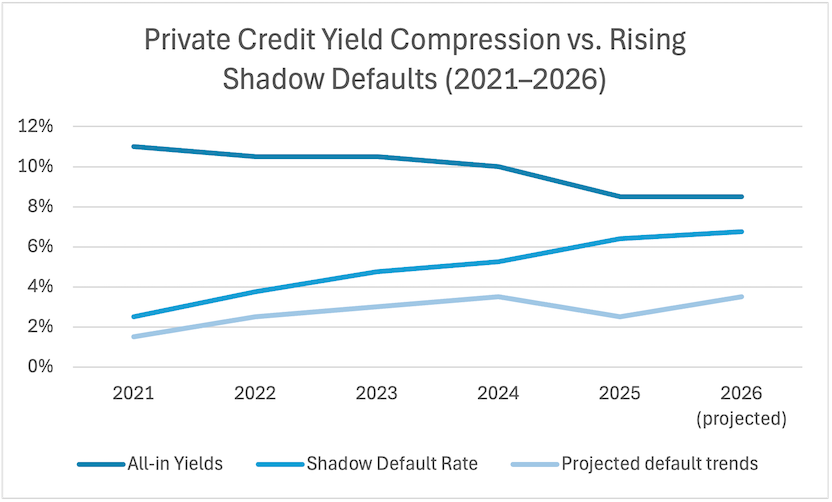
As private credit matures in 2026, risks are evolving. Increasing competition has compressed yields to 8–8.5%, potentially eroding the illiquidity premium and raising "shadow default" rates (restructurings and amendments that avoid formal default) as borrowers opt for modifications over outright defaults. Liquidity concerns may intensify with rapid growth in complex structures, though interconnections with banks could provide stability by enabling risk-sharing.
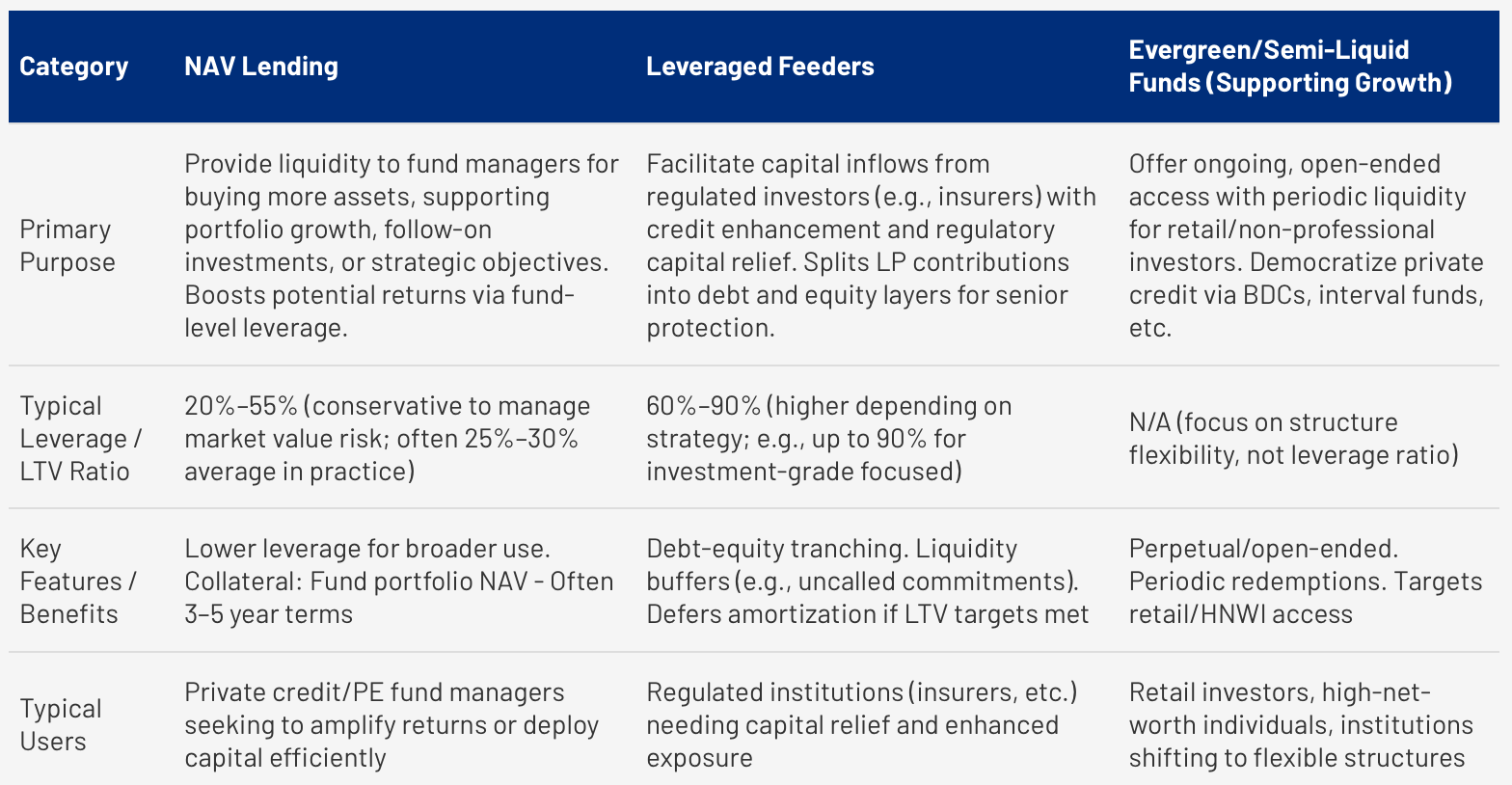
In fund finance, two common structures serve different purposes. NAV lending typically involves borrowing at 20–55% of the fund's loan-to-value ratio, allowing managers to increase potential returns by using borrowed capital to acquire additional assets or support existing investments. Leveraged feeders use higher leverage, usually 60–90% depending on strategy, and make it easier for regulated institutions to participate by splitting contributions into debt and equity layers, often with safety features such as reserved uncalled capital commitments. Significant risk transfers (SRTs) allow banks to pass credit risk from their loans to private credit funds, typically involving commercial loans or SME lending, with funds then adding leverage via repurchase agreements or NAV facilities.
As interest from everyday investors grows through vehicles like business development companies and ETFs, institutional managers may move toward more specialized, less liquid areas, driving further innovation. Access for retail investors is expanding rapidly via semi-liquid and evergreen funds. These now hold a substantial share of the US direct lending market, with evergreen private credit funds reaching approximately $644 billion in AUM as of mid-2025. Projections suggest retail involvement in private credit will continue to grow substantially by 2030, though this trend may encourage big institutions to focus on niche, less liquid opportunities such as asset-based finance.
2026 is shaping up as private credit's first substantive credit-cycle test. While global AUM is still on track to exceed $2 trillion, and approach $4 trillion by 2030, growth will be more dispersed: strong in asset-backed finance (especially data centers, infrastructure, and AI-related lending), special situations, and larger deals, but tempered in core direct lending by heightened competition from returning banks and greater manager selectivity. Refinancing needs peaking in 2028 remain a tailwind for hybrid public–private solutions.
The sector's maturation (greater transparency demands, standardization, and liquidity-management discipline) will be accelerated by recent events. Yet its core strengths in certainty of execution, flexibility, and diversification position it to support lower-tier borrowers and capture new opportunities. Private credit is aiming to cement itself as a core pillar of corporate finance, now trying to prove its resilience under real stress.